
AI use policy template for banks and credit unions.
Your staff are already using Microsoft Copilot, ChatGPT, and other AI assistants. Set clear boundaries that protect customer and member data without shutting down productivity. Both templates are ready to adapt for your employee handbook and governance documentation.
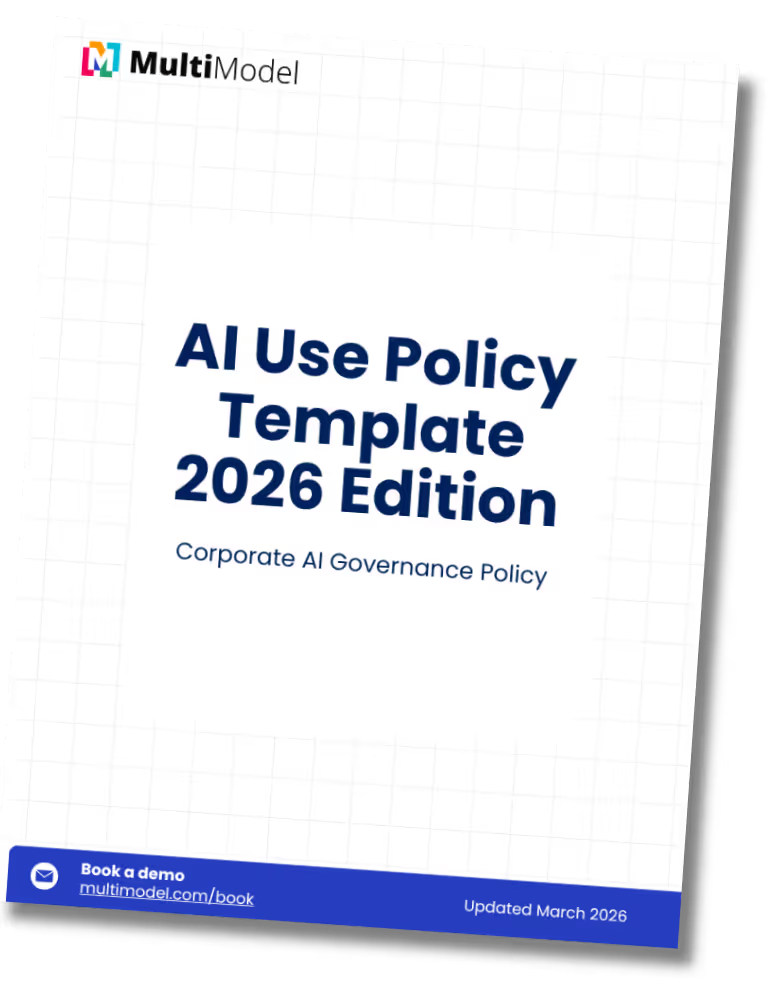
You'll get two templates
- Employee handbook addendum for AI assistant use at banks and credit unions
- Corporate AI governance policy for banks and credit unions
Based on guidance from FFIEC regulators, the NIST AI Risk Management Framework, and ISO/IEC 27001:2022.
Email me the templates
This site is protected by reCAPTCHA and the Google Privacy Policy and Terms of Service apply.
The first document your examiners ask for.
A written AI use policy tells your staff what they may and may not do with AI tools, and shows regulators that AI is governed like any other technology risk. These templates give your compliance, IT, and HR teams a starting point written for how a bank or credit union works, so you can adapt them instead of starting from a blank page.
- Clear rules your staff can follow, for the employee handbook
- Governance roles, oversight, and accountability for your leadership
- Aligned to the frameworks your auditors already use


Enforce the policy at the prompt, not just on paper.
MultiModel gives your staff the leading AI models inside your perimeter, with the controls your policy describes already switched on.
Protect member NPI
Account numbers, SSNs, and other personal data are redacted on the device before a prompt reaches any model.
Control who uses what
Models are provisioned by user, group, and policy.
Keep the record
Word-for-word prompt logs are retained, and every audit access is itself recorded.
Trusted by credit unions and banks
“We chose MultiModel for its financial-grade security, prebuilt prompts for financial institutions, and centralized AI portal that lets us safely operationalize generative AI across routine business processes.”
“We are very happy with our MultiModel experience. They have made staying on top of AI easy and simple for our team.”
“The AI portal allows employees to use and test GenAI capabilities in a sandboxed and controlled space rather than circumventing company policies and controls. Our experience has been fantastic.”
AI use policy template: FAQ
Straight answers for CIOs, CISOs, and compliance officers evaluating AI.
Talk to usWho is this AI use policy template for?
It is for your bank or credit union if you want to let your staff use AI assistants such as Microsoft Copilot and ChatGPT with clear rules in place. It is written for your compliance, IT, information security, and HR teams, who own the policy.
What frameworks is the template based on?
Guidance from FFIEC regulators, the NIST AI Risk Management Framework, and ISO/IEC 27001:2022. You should still review it with your own counsel and compliance team and adapt it to your institution.
What is the difference between the two templates?
The employee handbook addendum sets out what your staff may and may not do with AI assistants day to day. The corporate AI governance policy covers how you oversee AI: roles, accountability, and controls. You will usually want both.
How do we enforce the policy once it's written?
A policy on the shared drive does not stop someone pasting member data into a consumer chatbot. MultiModel turns the policy into rules in the AI portal: which models each group can use, on-device redaction of sensitive data, SSO-based access, and word-for-word prompt logs. See AI for banks and credit unions.
Is there a version for other industries?
Yes. There is a general AI use policy template, plus versions for investment managers and healthcare providers.
Turn your AI policy into enforced controls.
We'll show you how each section of your policy becomes a rule in the portal, with the audit trail your examiners will ask for.